
Explaining card holds on tabs
BREW POS merchant guide. For when a customer says they have been charged twice.
The short version
When a customer opens a tab on a card, your system asks their bank to set an amount aside. That is a hold, not a charge: no money moves, and it appears on their phone as pending, at the amount you held rather than the amount they spent. When you close the tab you send the real total, and that is the only amount that ever leaves their account.
Because the two amounts are different, a customer can see both on screen at once for a day or so and conclude they have been billed twice. They have not, and they cannot be.
You control how big the hold is, through the CC Preauth setting for each venue. You do not control when it disappears from their banking app, which is their bank's timing and normally takes a day or two.
Two pending amounts usually means one of two things. Either two tabs were opened for them that night, or there was a communication problem with their bank: the card machine asked for the hold and the bank took too long to answer. It is rare, but it happens. Either way their bank drops the hold when nothing settles against it, and only their bank can say when, because every bank has its own policy. If it says pending, it is not a charge.
The first check
Is the amount marked pending, or is it a finalized charge? Ask that before anything else, because the two go to completely different places.
Pending means nothing has been taken. It is a hold, not a charge, and no money has moved. That is what this guide is about, and it is what almost every one of these calls turns out to be.
Finalized, or posted, means money actually moved. If a customer has two genuinely finalized charges for one tab, that is not a hold and this guide does not cover it. That is a duplicate settlement and it goes to your card processor.
So get them to read you the word next to the amount, or ask whether it says pending. Everything below assumes it does.
If it says pending, this is what to say. Put your own total in: That pending amount is the hold we put on when you opened the tab, not your bill. Your actual total was 58.42 and that is the only amount that will come out. The hold usually drops off in a day or two, though that part is down to your bank rather than us.
That settles most of these on the spot. The rest of this guide is for the ones it does not.
What it looks like
Friday night at Barking Pup. CC Preauth for that venue is 75.00, so when a customer opens a tab the system asks their bank to set 75.00 aside. Their phone shows 75.00 pending within seconds, before they have finished the first drink.
They spend 48.42 and leave a 10.00 tip. You close the tab and settle 58.42. On Saturday their app shows both amounts: 75.00 still pending, and 58.42 posted. They call you and say they have been charged twice.
Only the 58.42 will ever leave their account. The 75.00 is the hold, it cannot take money, and it drops off on its own.
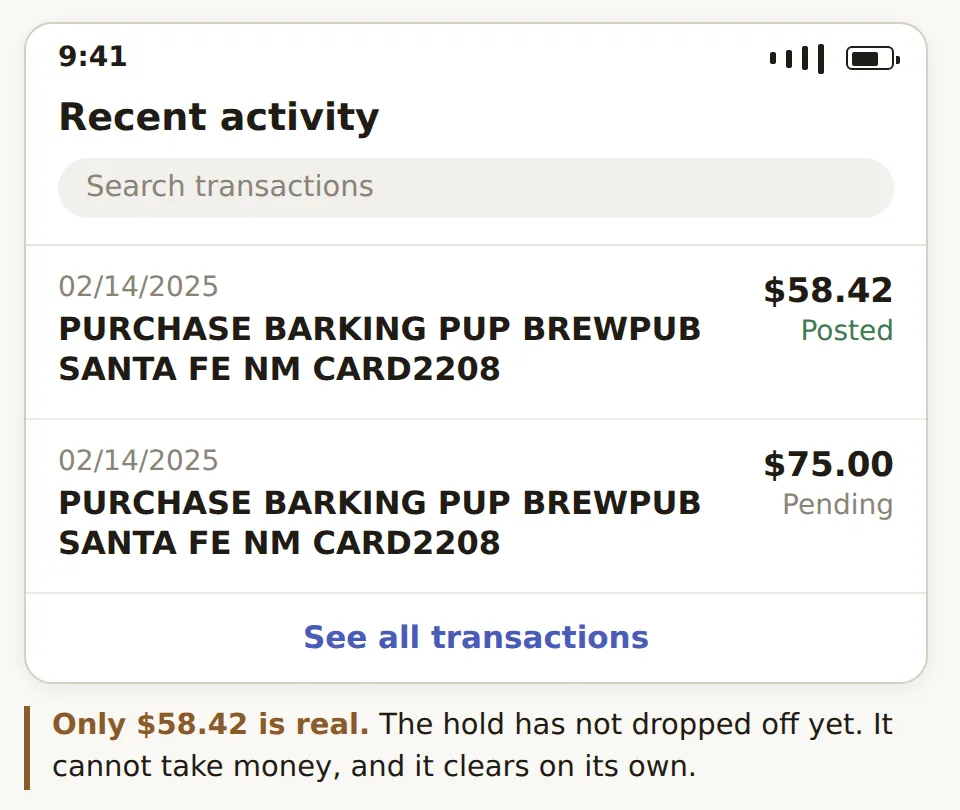
The same tab before and after it settles. The hold and the real charge are different amounts, so for a day or so both are on screen at once.
What actually happens when a tab opens
There are two separate messages between you and your customer's bank, and almost every complaint comes from people assuming there is only one.
Message one, when the tab opens: the authorization. Your system asks the customer's bank to approve an amount. The bank checks the account, approves it, and returns an authorization code. It then sets that amount aside. No money leaves the account.
On a credit card, the amount comes off their available credit. Their statement balance does not change and no interest accrues on it.
On a debit card, it comes off their available balance. The money is still in the account, and the current balance still shows it, but they cannot spend it. This is the version that causes real trouble, because it is the customer's own money that has gone out of reach, and it is the version that can trigger an overdraft fee.
Message two, when the tab closes: the settlement. You send the real total, bill plus tip. This is the message that actually moves money, and it is the only one that ever appears on a statement. It usually posts in one to three business days.
Between those two messages, the bank is holding an authorization it has not yet matched to anything. That gap is what this guide is about.
How the bank records it
The bank logs the authorization against the account with its amount, the date, your merchant name and the authorization code. It reduces the available balance and waits for a matching settlement to arrive.
It does not post the hold to the statement. A hold has no statement line, no transaction reference a customer can dispute, and no confirmation when it is released. It exists only as a reduction in what they can spend.
When settlement arrives, the bank matches it to the authorization, releases the hold and posts the real charge. When settlement never arrives, the authorization expires on the bank's own timer and the available balance quietly goes back up.
What your customer sees on their phone
Usually one word: Pending, with your venue's name next to it.
Banks do not use the same language. Chase calls it an authorization hold and also shows it as a pending charge. Capital One tends to say pending transaction rather than hold. Wells Fargo uses both on the same page. So you cannot tell a customer what their app will call it, and you should not try.
The amount they see is the hold amount, not what they have spent. This is the sentence that resolves most conversations. A customer who bought one beer and sees 75.00 pending has not been charged 75.00 for a beer. They are seeing the amount set aside when the tab opened.
Their bank says the same thing, which is worth knowing because customers believe their bank. Capital One tells its customers that while a transaction is pending the amount may change, and gives a restaurant as the example. Wells Fargo warns that for tip taking businesses there can be a significant difference between the amount authorized first and the amount that finally posts.
When a customer says they were charged twice
They will only ever be billed once. A hold cannot take money. It has no mechanism to do so. Only a settlement moves funds, and you sent one.
Check first whether two tabs were opened for them that night. Two tabs means two holds, and that one is yours to explain rather than the bank's. If it was one tab, the cause is below.
An authorization that failed for you and worked for them
This is rarer, more alarming, and entirely outside your control.
When a tab opens, your system asks the customer's bank to approve the hold. Sometimes that request times out or is cancelled before the answer gets back. Your staff see a failure message, so they run the card again, or take a different card.
The problem is what happened at the other end. The bank received the request, approved it, and set the money aside. The approval just never made it back to you. So your system correctly reports that the authorization failed, while the customer's bank has already placed a hold and, in some cases, goes on to post it.
The result is a customer looking at two pending amounts for a tab they only ever opened once.
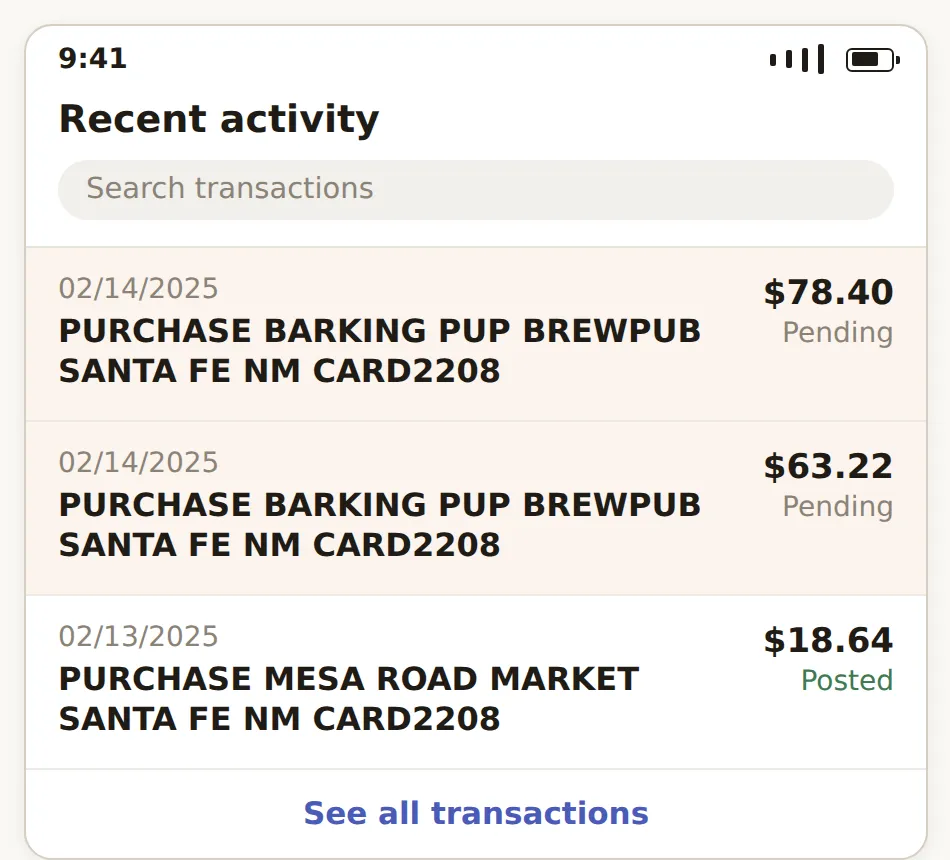
Two holds from one tab. The card was run twice because the first attempt reported a failure, and the customer's bank held both.
What the customer should do
Two routes, and the first is faster.
Call the bank or card company, using the number on the back of the card, and ask them to remove the authorization that never completed. They should cite the other transaction, the one that settled properly, as evidence that the tab was paid once and the duplicate is an orphan.
Or wait. The bank will drop the authorization automatically when it expires, on whatever timer that account runs to. In BREW POS experience across merchants that is typically between 3 and 10 days, depending on the bank's own rules. It is not a figure any bank publishes, so offer it as what usually happens rather than as a promise.
That waiting figure is longer than the one to two days quoted elsewhere in this guide, and that is not a contradiction. A normal hold is killed early by the settlement arriving and matching it. A failed authorization has no settlement coming, so nothing cuts it short and it runs to its full expiry.
Watch out: do not promise to fix this one
With the ordinary hold you can at least say the settlement is on its way. With a failed authorization there is nothing on its way, because your system has no record of a successful authorization to reverse.
Be straight about it. Tell them it is a fault at their bank, tell them it usually clears on its own within about 3 to 10 days, and give them what they need to get it cleared sooner. Do not offer to call their bank on their behalf and do not tell them you have released it.
Give them the settled receipt showing the single real amount. A bank cannot find a hold from a description, but the date, the amount and your venue name give it enough to locate both entries, see that one settled and one never did, and release the orphan.
How long the hold takes to go
For a restaurant or bar, one to two business days is the normal answer, and up to a week at a slow bank. Restaurants sit at the short end of every published range, because the final bill arrives the same night.
Most customers: 1 to 2 business days after you close the tab. Slower banks: up to 5 days. A hold with no settlement coming: 3 to 10 days, to its full expiry. Capital One publishes that pending items can remain up to 5 days, Chase says a few days to a week, and Wells Fargo says most debit requests are received within 3 business days.
If a customer asks how to avoid this next time, the answer is to open the tab on a credit card rather than a debit card. The hold then reduces available credit instead of their own cash, costs them nothing, and accrues no interest.
Ignore the thirty day figures. Customers search this, find two week and thirty day numbers, panic, and bring them to you. Those come from hotels, car rental and cruise lines, which the card networks give a much longer window precisely because their final bills arrive much later. A bar tab is none of those.
Whose problem this is
Partly yours, mostly theirs, and being precise about which part is which is what keeps you out of an argument you cannot win.
Yours: how big the hold is, which is your CC Preauth setting. Closing tabs the same night rather than leaving them open. Settling promptly, so the real charge arrives and clears the hold.
Theirs, meaning the customer's bank: when the hold actually vanishes from the app. Whether the hold and the settlement get matched to each other or shown side by side. Whether a release sent this afternoon is processed tonight or in two days. Whether an authorization that failed on your side gets held and posted anyway on theirs. Whether a debit hold triggers an overdraft fee.
Only the card issuer can remove a hold. Not you, not BREW POS, not your processor, not the card network.
Watch out: never tell a customer their bank has already released it
Even when a release has gone out, you have no idea when their bank will act on it, and banks commonly post these in an overnight batch.
Say that their bank posts it on their own schedule instead. A customer who is told the money is back and then finds it is not comes back much angrier, and now they think you lied to them.
The one setting you control
Setup, then Settings, then Locations, then Charges, then CC Preauth. It is the amount held when a card opens a tab, and it is set per venue.
Step 1. In BREW POS Admin, go to Setup then Settings, then the Locations tab. This needs Settings access. If Setup opens without a Settings tab, ask whoever manages staff records.
Step 2. Choose the venue.
Step 3. Open Charges.
Step 4. Set CC Preauth to a little above a typical tab at that venue.
Step 5. Click Save. Settings has its own Save, greyed out until something changes, and nothing takes effect until you use it. The new amount applies to tabs opened at that venue from then on. Tabs already open keep the hold they were given.
Too low and tabs run past the hold, which means re-authorizing mid service or risking the settlement being refused. Too high and every customer sees an alarming pending amount they did not spend. A 100.00 hold at a venue where the average tab is 35.00 buys you nothing and generates complaints every night.
Set it per venue, not once. A quiet neighbourhood bar and a Friday night music venue do not have the same typical tab, and the setting lives on the location record for that reason.
What to do when a customer complains
Most of these end at step 2.
Step 1. Ask whether the amount says pending or finalized. Two finalized charges is a duplicate settlement and goes to your processor, not here.
Step 2. Tell them the pending amount is the tab hold, not their bill. Give them the actual total you settled. In most cases the gap between the two explains everything and the conversation ends here.
Step 3. If they can see both a pending amount and a posted charge, tell them the posted one is the real charge, the pending one is the hold that has not dropped off yet, and only one will ever come out of their account.
When the hold has been sitting for several days, add this: if it is still showing after a few days, call the number on the back of your card. They can see both of them and release the one that never went through.
Questions you will be asked
Am I doing something wrong?
No. A hold is how every card tab works, everywhere. The only part you control is the size of it, and complaints about the size are a CC Preauth setting, not a fault.
Can I open tabs without holding a card?
You can, and some venues do, but you are then carrying the risk of the walkout yourself. The hold is what makes an abandoned tab collectable.
Should I just lower the preauth so nobody complains?
Lower it to a little above a typical tab for that venue, and no lower. Set it under what people actually spend and you trade customer complaints for tabs that exceed the hold, which is a worse problem because it costs you money rather than goodwill.
Does closing the tab release the hold straight away?
Closing the tab sends the settlement, which is what tells the bank to release the hold and post the real charge. How fast the bank acts on that is theirs, not yours. Usually a day or two.
A customer walked out on their tab. What do I do with the hold?
Settle it, which turns the hold into a real charge. If you are not going to charge it, leave it. The hold is never converted into anything and it expires on its own.
Why do debit customers complain more?
Because it is their own money that has gone out of reach, not a line of credit. A debit hold can leave them short at the next shop, and it can trigger an overdraft fee. A credit card hold reduces available credit only, costs them nothing and accrues no interest.
A customer wants me to phone their bank. Should I?
No, and you would not get far. Banks will generally not discuss a cardholder's account with a merchant. Give the customer the settled receipt and let them make the call, which is the route that actually works.
Can I be charged back over a hold?
Not over the hold itself, because no money moved. A settlement that comes in well above the amount that was authorized can be challenged, which is the practical reason not to let tabs run far past their hold.
Does this happen more with some banks than others?
Yes, noticeably. Release timing and the failed authorization problem both vary by issuer, and you will see the same two or three banks behind most of your complaints. There is nothing you can do about that beyond recognising the pattern, so you are not hunting for a fault at your end.
If something looks wrong
Customer sees a pending amount larger than their bill. That is the CC Preauth hold, set per venue. Working as intended. Check the amount is sensible for that venue.
Customer sees a pending amount and a posted charge together. The hold and the settlement were different amounts, so the bank has not matched them. Only the posted one is real.
Customer has two pending amounts and the card was run twice. An authorization failed for you and was held by their bank anyway. Theirs to clear. Send them to their bank.
Every customer at one venue reports an alarming hold. CC Preauth is set too high for that venue. Setup, Settings, Locations, Charges.
Tabs are exceeding the hold. CC Preauth is too low for that venue. Raise it, but only to a little above a typical tab.
Hold still showing after a week. Give the customer the settled receipt and send them to their bank. You cannot release it.
Customer insists you charged them twice. Check pending or finalized first. If one is pending, only the posted one is real. Show them the settled receipt with the single amount.
Two charges, both finalized, one tab. Not a hold. That is a duplicate settlement, and it goes to your card processor.
Customer says their bank told them to call you. Their bank can release the hold and you cannot. Give them the settled receipt and send them back.
Still stuck?
Call BREW POS support on the number in the footer. Have the tab date, the venue, the total you settled, and the pending amount the customer is reading to you.
If the hold is sitting at the customer's bank, we cannot remove it either. What we can do is confirm from your records what was authorized and what settled, so the customer has the dates and amounts their bank needs.
Updated 13 September 2026 · BREW POS Admin, 4 September 2026 snapshot · Card network rules as published September 2026
BrewPOS How to use
Support 1-800-676-9874
Email [email protected]
© 2026 BREW POS. All rights reserved.
Privacy Policy | Terms and Conditions